Rules and planning
Dog-friendly camping in Australia: verify the rules before booking
Before booking dog-friendly camping in Australia, confirm the land manager, the named campsite's rule, on-lead areas, alerts such as 1080 baiting and entry signs.
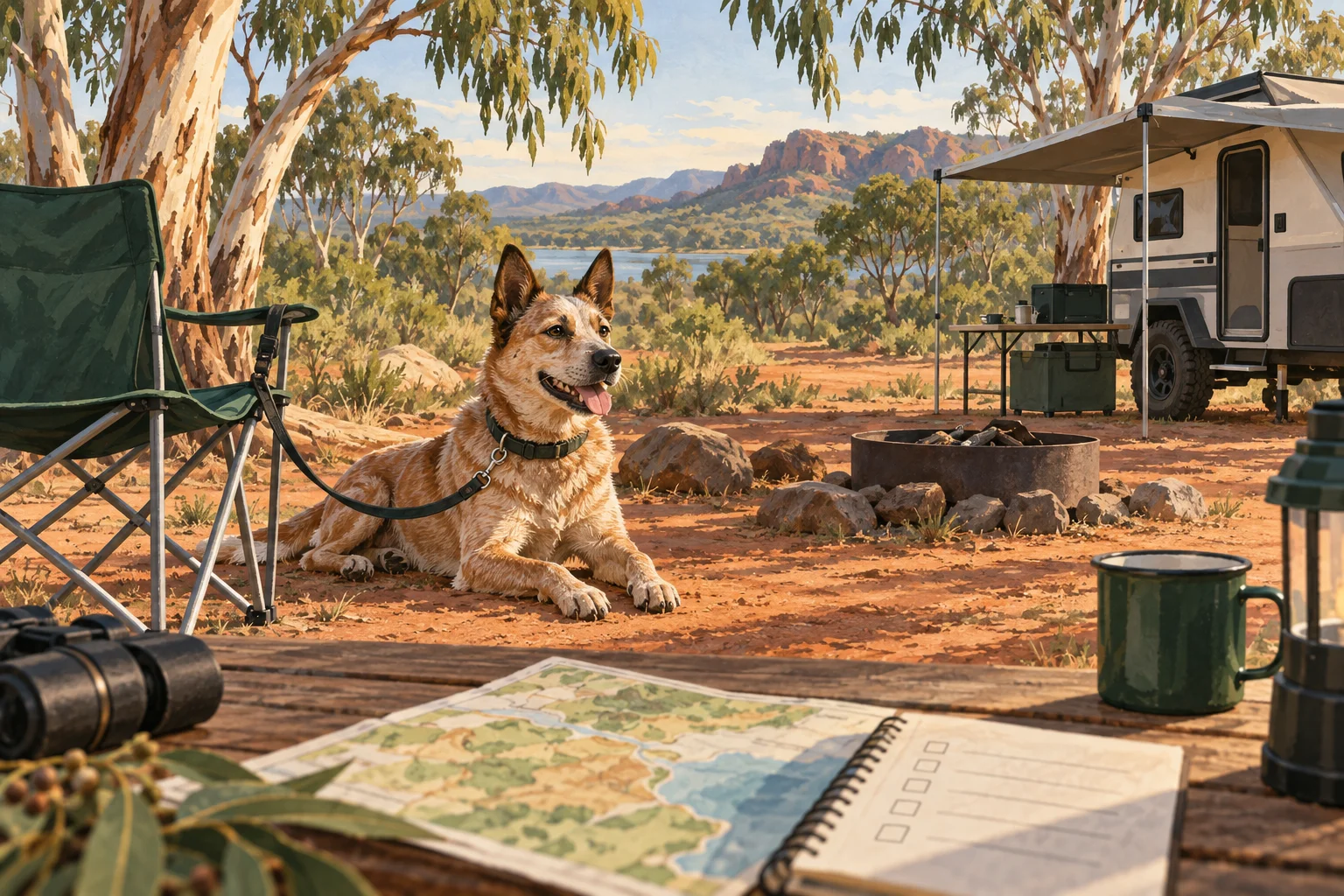
Dog-friendly camping in Australia is verified at the exact campsite, not from a broad label such as “State forest”, “regional park” or “pet friendly”. Identify the land manager, open its current page for the named camping area, record where the dog may go and under what control, then check booking conditions, alerts and entrance signs. If those sources do not produce a clear answer, the campsite is unverified, not dog friendly by default.
The shortest reliable test is: exact place, exact rule, current conditions. A directory filter, map pin, old social post or booking receipt can help you find a candidate, but none replaces the authority that manages the land.
Geographic scope: this is an Australia-wide verification method, illustrated with current official examples from New South Wales, Queensland and Victoria. Pet rules are set by the relevant jurisdiction and land manager, and can differ between adjoining areas or individual campsites. The rule examples below were checked on 14 September 2026. They must be checked again for the planned trip. The verification workflow and checklists are general planning advice; the quoted permissions and prohibitions are current local rules.
Dog-friendly camping in Australia needs six pieces of evidence
Treat “dogs allowed” as a conclusion supported by six layers. Each layer answers a different question.
| Evidence | What it must establish | What is not enough |
|---|---|---|
| Place identity | The official name, boundary and camping area match the place you intend to use | A map pin, nearby town or shared nickname |
| Land manager | The council, parks agency, forestry body, Traditional Owner organisation or private operator responsible for the site | The word “reserve”, “forest” or “park” by itself |
| Campsite rule | Dogs are permitted at the named campsite on the intended dates | A statewide pet-friendly list with no campsite detail |
| Movement rule | Where the dog may walk, whether a lead is required and which adjoining areas are prohibited | Permission to sleep at the campsite |
| Current control | Closures, pest-control notices, wildlife measures and other temporary restrictions do not defeat the plan | An undated search snippet or saved page from an earlier trip |
| Arrival check | Current signs, barriers and staff directions still agree with the online plan | A booking confirmation shown against a prohibition sign |
If one layer is silent, contact the manager using the details on its official site. Ask a closed question: “May I bring one pet dog to this named camping area on these dates, and must it remain on a lead at the campsite and on the route from the entrance?” Save the response with the date and the name or team that supplied it.
Why the land category cannot answer the question
Official rules show why a broad search for “dog-friendly forest camping” can mislead.
In NSW, National Parks and Wildlife Service says dogs and other pets are generally not permitted in national parks and reserves. It identifies limited permissions in some regional parks and says dogs are welcome in NSW State forests. Its dog-walking guidance still requires a dog in a permitted regional park or State forest to remain under effective control, and the permission may apply only to named tracks, beaches, campgrounds or other designated areas.
Forestry Corporation of NSW separately says dogs are welcome in all NSW State forests, must remain under control, and should not cross into adjoining national parks where they are prohibited. That general permission does not identify a lawful camping location, prove access or clear a temporary forest notice. Use it beside the exact forest and camping information. Our NSW State forest camping guide covers those separate checks.
Queensland makes the campsite-level test even clearer. Queensland Parks and Wildlife Service says dogs and other pets are welcome in some conservation parks, State forests and recreation areas, but not in national parks. Its current page lists particular camping areas where dogs may be brought on a lead. Yet the official page for Charlie Moreland camping area in Imbil State Forest expressly prohibits dogs and other domestic animals within that camping area. “State forest” therefore cannot be used as a permission statement in Queensland.
Victoria supplies the reverse lesson. Parks Victoria’s dog-friendly camping page says dogs are generally not permitted in protected national parks, then identifies particular camping areas where dogs are accepted on lead. Its page for Lake Elizabeth Campground in Great Otway National Park states that dogs are permitted on lead there. The exception belongs to that named area; it is not permission for the rest of the national park.
These examples are not a national table of where to camp. They demonstrate the method: a land category starts the search; the exact current campsite page resolves it.
Verify the exact campsite before paying
Start from the land manager’s own website. Search the official name in quotation marks if necessary, then make sure the page describes the camping area rather than a nearby day-use area, beach or walking track.
Capture these fields in a trip note:
| Field | Your evidence |
|---|---|
| Official campsite name | |
| State or territory | |
| Land manager and direct page | |
| Dogs permitted, prohibited or not stated | |
| Areas included in the permission | |
| Areas excluded | |
| Lead or effective-control wording | |
| Number-of-dogs or site conditions, if stated | |
| Booking declaration or approval required | |
| Alert and baiting check | |
| Source check date and time | |
| Manager contact, if clarification was needed |
Read the complete page, including tabs labelled warnings, restrictions, pets, when you’re there, camping conditions or important information. On some sites, the dog rule sits below the booking button or inside an expandable panel. A search-result extract can omit the restriction or retain wording after the source has changed.
Do not pay until the campsite, access route and intended activities all work with the dog. A non-refundable booking does not convert an unclear rule into permission.
Check the whole trip, not only the sleeping area
A dog may be permitted at a campsite but excluded from the track, beach, picnic area, playground or protected land beside it. Build a small boundary map from official sources before travel.
Check each part separately:
- the public-road approach and any park road traversed with the dog in the vehicle;
- the parking or unloading area;
- the booked pitch or authorised camping zone;
- toilets, water points and shared cooking areas;
- the walking route intended for exercise;
- adjoining beaches, reserves, national parks and private land; and
- the return route if it differs from the approach.
The NSW National Parks guidance illustrates how narrow a permission can be: some regional-park rules name only particular beaches, trails or campgrounds. It also publishes conditions for driving through certain parks with a pet in a vehicle. Do not generalise either permission to a different park or route.
Where a boundary is uncertain, keep the dog on the verified side and contact the responsible manager. The free camping rules in NSW guide explains how to identify the land manager before relying on a general public-land label.
Translate the dog rule without softening it
Copy the authority’s words into the trip note. Small differences change the plan.
| Published wording | Practical reading |
|---|---|
| Dogs prohibited | Do not bring a pet dog into the stated area, including the campsite if it is within scope |
| Dogs permitted on lead | Keep the dog attached to a suitable lead throughout the stated area; “under control” is not a substitute for the lead |
| Under effective control | Follow the manager’s definition and every local sign; ask if the page does not explain what control requires |
| Dogs permitted at selected sites | Book only a site expressly included, and verify access between the entrance and that site |
| Dog-friendly park or forest | Open the exact campsite and activity pages; the label alone does not define the permitted zone |
| Pets not stated | Treat the answer as unknown and obtain confirmation before booking |
Do not turn “on lead” into “on lead near other people”, or “permitted at the campground” into off-lead access on surrounding tracks. Bring bags and remove dog waste as the manager directs. Plan enough water and food for the dog without assuming the site’s water is potable or available; verify facilities independently.
Read alerts for 1080 baiting and other temporary controls
A standing dog permission is not a safety clearance. Open the land manager’s current alerts, closures and pest-management notices for the exact campsite, the surrounding area and the access route. Our guide to reading campground local alerts provides a repeatable way to capture the affected place, dates and required action.
In NSW, 1080 bait products are used under regulated controls for pest animals. NSW Government guidance says warning signs must identify the baiting activity and warn that other animals, including domestic dogs, may be affected. It also warns that secondary poisoning can occur if a dog eats the remains of an animal that consumed bait. If you suspect a dog has eaten a 1080 bait, the official advice is to contact a veterinarian immediately.
Turn that into a firm decision rule:
- read current online notices before departure;
- stop at every poison or pest-control sign rather than driving past it on the strength of a saved permission page;
- keep the dog out of the signed baiting location;
- do not allow scavenging of baits or animal remains; and
- seek immediate veterinary help if exposure is suspected.
That source and instruction are specific to NSW. For another jurisdiction, use its environment, agriculture or land-manager guidance and follow the local notice. Do not infer that the absence of an online alert proves the absence of a hazard; inspect current entrance and campsite signs.
Keep assistance-animal access separate from pet rules
An assistance animal is not simply a pet allowed by a dog-friendly filter. The Australian Human Rights Commission explains that the Disability Discrimination Act 1992 protects qualifying assistance animals and sets out different ways an animal can meet the federal definition, including relevant accreditation or training that assists a person with disability together with appropriate hygiene and behaviour standards.
Land managers also publish operational guidance. NSW National Parks says trained assistance animals may enter areas open to the public when reasonable proof is available, and recommends contacting the local office when booking park accommodation. Queensland publishes separate requirements for certified support dogs and assistance animals in managed areas.
If this applies to the trip, use the land manager’s assistance-animal policy rather than its ordinary pet icon. Contact the manager before booking to clarify the documentation and arrangements for the exact facility. That planning contact is not a substitute for legal rights, and this practical guide is not legal advice.
Make a go, no-go or unresolved decision
Use three outcomes. “Probably” is not one of them.
| Finding | Decision |
|---|---|
| Exact campsite page permits dogs, all relevant zones and conditions are understood, current notices are clear | Go, subject to a final check and arrival signs |
| Exact page prohibits dogs, the booked site is outside the permitted zone, or a current control excludes them | No-go with the dog; change the site or care arrangement |
| Official sources conflict, the pet field is blank, the boundary is uncertain or the latest notice cannot be interpreted | Unresolved; contact the manager or choose another site |
Take a dated screenshot or offline copy of the campsite rule, relevant map, booking conditions and alerts. This records the basis of the plan but does not freeze the rule. Recheck after a material event or manager update, on the day before departure and at the last reliable connection. At the entrance, a closure, prohibition, baiting sign or authorised direction defeats the saved plan.
Dog-friendly campsite verification checklist
- The official campsite name and land manager are confirmed.
- The exact camping-area page expressly permits the dog; silence has not been treated as approval.
- The permission covers the booked pitch or camping zone and the intended dates.
- Lead, control, waste, number-of-dogs and other published conditions are recorded exactly.
- Parking, access roads, walking routes, beaches and adjoining land have been checked separately.
- The booking terms agree with the campsite page, and any conflict has been resolved with the manager.
- Current closures, wildlife measures, pest-control notices and baiting warnings have been read.
- Food, water, waste bags, restraint and veterinary contact details do not depend on unverified facilities or reception.
- The rule, map, booking conditions and alerts are saved offline with the check time.
- A lawful fallback exists if the current rule or on-site control changes.
- Entrance and campsite signs will be followed even if an earlier screenshot differs.
The useful answer is deliberately narrow: a campsite is dog friendly only when the current authority permits your dog at that exact place, the route and activities stay inside the permitted area, every condition is workable and no later notice or sign withdraws the permission.
This guide is desk research from the primary Australian sources listed below. It does not report a campsite visit, destination review, GPS coordinate, track condition, signal test, visit date, photograph or field observation.
Sources
Primary sources checked on the dates shown. Rules and access conditions can change; recheck the linked authority before travel.
- Pets and animals in national parks — NSW National Parks and Wildlife Service, accessed 14 September 2026.
- Dog walking in parks — NSW National Parks and Wildlife Service, accessed 14 September 2026.
- Dogs in state forests — Forestry Corporation of NSW, accessed 14 September 2026.
- Dogs and pets — Queensland Parks and Wildlife Service, accessed 14 September 2026.
- Charlie Moreland camping area — Queensland Parks and Wildlife Service, accessed 14 September 2026.
- Dog friendly camping — Parks Victoria, accessed 14 September 2026.
- Lake Elizabeth Campground — Parks Victoria, accessed 14 September 2026.
- Using 1080 baits in NSW — NSW Government, accessed 14 September 2026.
- Assistance animals and the Disability Discrimination Act 1992 (Cth) — Australian Human Rights Commission, accessed 14 September 2026.